
 PDF
PDF
Hydrological Simulation Analysis for The Design of The Sei Busui Batuaji-Kuaro Bridge in East Kalimantan, Indonesia
Article Sidebar
 https://doi.org/10.32487/nuce.v5i2.714
PDF downloads: 31
Main Article Content

Abstract
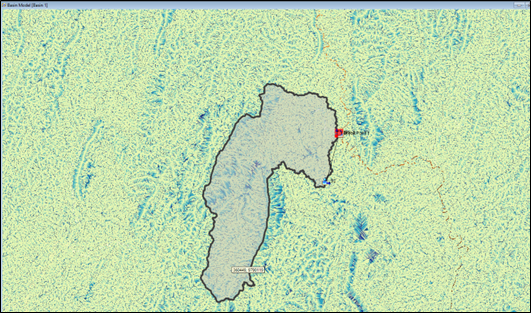
The Sei Busui Batuaji-Kuaro Bridge in East Kalimantan, Indonesia, is a critical infrastructure project requiring rigorous hydrological analysis to ensure resilience against extreme flood events. This study presents a comprehensive hydrological simulation to determine design flood discharges and maximum water levels (MWL) using rainfall data from 2016–2025. Rainfall frequency analysis employed the Log Pearson Type III distribution, validated with Chi-square and Smirnov-Kolmogorov tests. Flood discharges were estimated using five methods: Rational, Weduwen, Haspers, HSS-Gamma I, and HSS-Nakayasu. The HSS-Gamma I method was selected for its applicability to medium-sized catchments (127.58 km²), yielding a design discharge of 1,623.15 m³/s for a 75-year return period. Hydraulic analysis confirmed a freeboard of 1.693 m, exceeding safety standards. The findings emphasize the importance of region-specific hydrological methods and continuous monitoring to mitigate flood risks
Downloads Statistics
Article Details

 This work is licensed under a Creative Commons Attribution-NonCommercial 4.0 International License. Any further distribution of this work must maintain attribution to the author(s) and the title of the work, journal citation and DOI.
References
Jones, R. T., & Patel, A. (2020). Cost implications of overdesign in infrastructure projects. Journal of Infrastructure Systems, 26(3), 4020019. https://doi.org/10.1061/(ASCE)IS.1943-555X.0000525
Kirono, D. C., & Hennessy, K. (2013). Changes in extreme rainfall in the south-west of Western Australia. Australian Meteorological and Oceanographic Journal, 63, 173–184.
Kirpich, Z. P. (1940). Time of concentration of small agricultural watersheds. Civil Engineering, 10(6), 362.
Klemeš, V. (1986). Operational testing of hydrological simulation models. Hydrological Sciences Journal, 31(3), 433–442. https://doi.org/10.1080/02626668609491052
Linsley, R. K., Kohler, M. A., & Paulhus, J. L. H. (1982). Hydrology for Engineers. McGraw-Hill.
Nations, U. (2015). Sendai Framework for Disaster Risk Reduction 2015-2030.
of Highways, D. G. (2016). Guidelines for Hydrological Analysis for Bridge Design.
of Public Works, M., & Housing. (2018). Technical Guidelines for Bridge Design in Indonesia.
on Climate Change (IPCC), I. P. (2021). Climate Change 2021: The Physical Science Basis. Cambridge University Press.
Ponce, V. M. (1989). Engineering Hydrology: Principles and Practices. Prentice Hall.
Singh, V. P. (1992). Hydrologic Systems: Rainfall-Runoff Modeling. Prentice Hall.
Smith, J. A., Baeck, M. L., Meierdiercks, K. J., Nelson, P. A., & Miller, A. J. (2018). Urban flooding in the United States: A new challenge. Journal of Hydrologic Engineering, 23(7), 4018019. https://doi.org/10.1061/(ASCE)HE.1943-5584.0001626
Soemarto, C. D. (1986). Hidrologi Teknik. Usaha Nasional.
Subramanya, K. (2015). Engineering Hydrology. McGraw-Hill Education.
Triatmodjo, B. (2009). Hidrologi Terapan. Beta Offset. .
(WMO), W. M. O. (2008). Guide to Hydrological Practices.
Yue, S., & Wang, C. Y. (2002). A comparison of the power of the t test, Mann-Kendall test and bootstrap test for detecting trends. Canadian Water Resources Journal, 27(4), 503–529. https://doi.org/10.4296/cwrj2002485
Zhang, Q., Singh, V. P., Li, J., Jiang, F., & Bai, P. (2011). Regionalization of low flow based on multiple catchment characteristics. Journal of Hydrologic Engineering, 16(10), 825–835. https://doi.org/10.1061/(ASCE)HE.1943-5584.0000371
Zhao, R. J. (1992). The Xinanjiang model applied in China. Journal of Hydrology, 135(1–4), 371–381. https://doi.org/10.1016/0022-1694(92)90096-B