
 PDF
PDF
Feasibility constraints in public works price adjustment weighting in Nepal
Article Sidebar
 https://doi.org/10.32487/nuce.v5i2.753
PDF downloads: 38
Main Article Content


Abstract
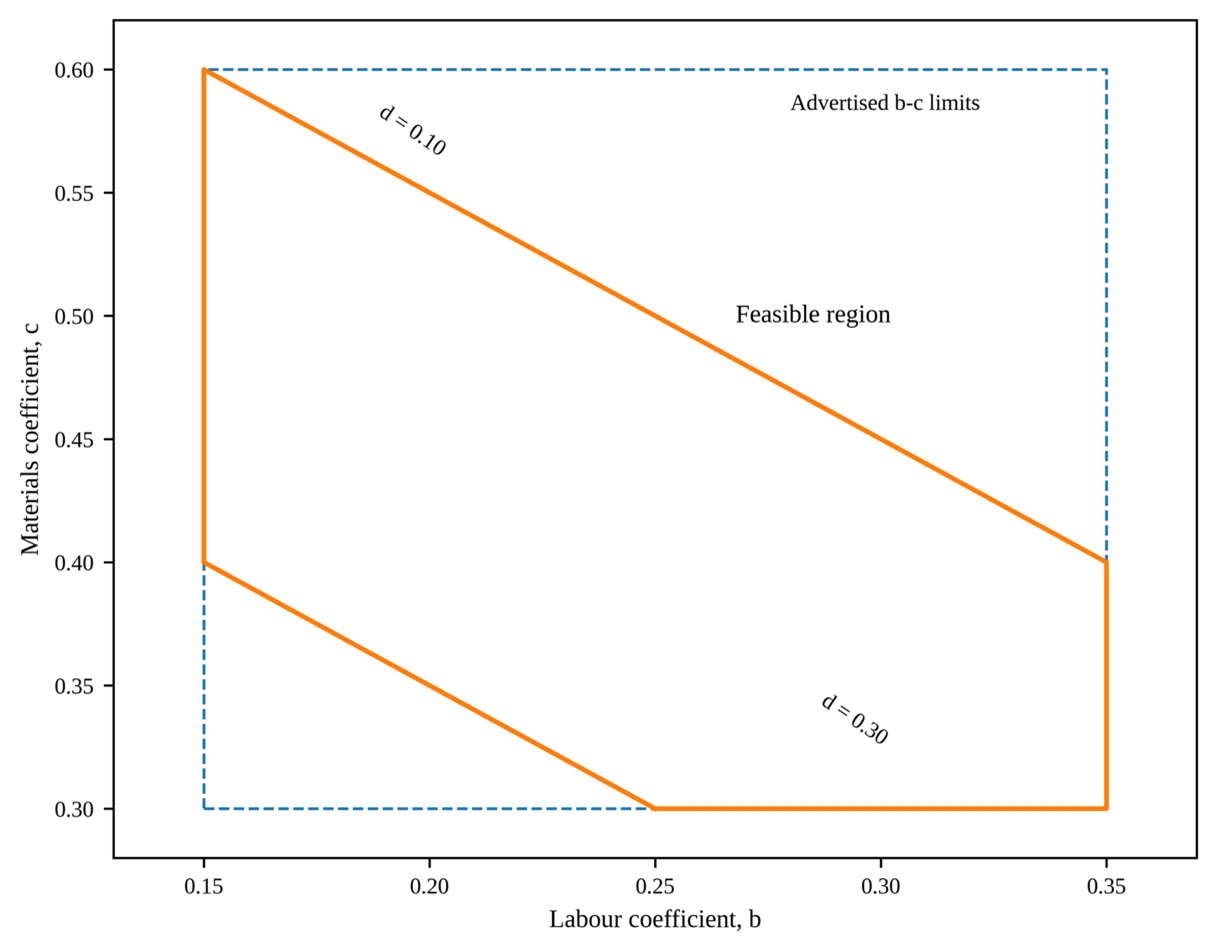
Price-adjustment clauses distribute construction cost fluctuation between public employers and contractors, but the weighting intervals written in bidding documents do not necessarily provide the discretion they appear to provide. This study audited 31 official Nepal e-GP works documents and collapsed repeated designs into 19 distinct coefficient-range specifications. For each specification, the feasible combinations of labour, materials and equipment coefficients were derived under the contractual normalization constraint with a non-adjustable coefficient of 0.15. Seventeen specifications produced polygonal feasible regions, whereas two nominal interval sets collapsed to a single admissible weighting. Among polygonal specifications, feasible area in the labour-material coefficient plane ranged from 0.0012 to 0.0350, a 29-fold difference. Historical sensitivity was then evaluated for eight specifications whose index sources were compatible with Nepal Rastra Bank construction labour, construction materials and machinery/equipment series. Under the 2022/23-2023/24 annual-average movement, the broadest specification permitted a 1.810 percentage-point spread in the adjustment factor, equivalent to about NPR 1.81 million per NPR 100 million of adjustment-eligible work. The results show that coefficient normalization should be checked explicitly when drafting and evaluating price-adjustment schedules.
Downloads Statistics
Article Details

 This work is licensed under a Creative Commons Attribution-NonCommercial 4.0 International License. Any further distribution of this work must maintain attribution to the author(s) and the title of the work, journal citation and DOI.
References
Chaudhary, N., & Sharma, M. (2023). Price adjustment practices and their impacts on bridge construction contracts. Journal of Productive Discourse, 1(1), 65-74. https://doi.org/10.5281/zenodo.7885372
Choi, M., Kim, J., & Kim, M. (2006). A study on the price escalation system in a construction contract. KSCE Journal of Civil Engineering, 10(4), 227-232. https://doi.org/10.1007/BF02830776
Government of Nepal, Public Procurement Monitoring Office. (2026). Procurements of NCB works, single-stage: Two envelope bidding procedure (value above NRs. 20 million) (Revised 12 August 2026). https://ppmo.gov.np/category/1208/
Kayastha, R., Kisi, K., & Chitrakar, Y. (2024). Analysis of price adjustment claim during project time extension. Journal of Legal Affairs and Dispute Resolution in Engineering and Construction, 16(1), 06523003. https://doi.org/10.1061/JLADAH.LADR-1063
Mishra, A. K., & Aithal, P. S. (2020). Operation of price adjustment in construction projects. International Journal of Case Studies in Business, IT, and Education, 4(2), 229-249. https://doi.org/10.5281/zenodo.4277033
Nepal Rastra Bank. (2026). Annual report 2024/25. https://www.nrb.org.np/contents/uploads/2026/05/Annual-Report-2024-25-English.pdf
Oliveira, R. A. F. de, Abreu, M. I., & Lopes, J. (2025). Selection and weight determination of factors for price adjustment formulae based on bill of quantities. Systems, 13(12), 1069. https://doi.org/10.3390/systems13121069
Pokharel, S., & Mishra, A. K. (2020). Price adjustment practice of road projects in Nepal. Journal of Advanced Research in Construction & Urban Architecture, 5(3&4), 20-31. https://doi.org/10.24321/2456.9925.202003
World Bank. (2020). Standard bidding documents: Procurement of works. https://documents1.worldbank.org/curated/en/323361581052752931/pdf/Standard-Bidding-Documents-Procurement-of-Works.pdf