
 PDF
PDF
Study of Furrow Planting System in the Limestone Reclamation Area of PT. "X", East Java Province
Article Sidebar
 https://doi.org/10.32487/nuce.v4i1.718
PDF downloads: 89
Main Article Content

Abstract
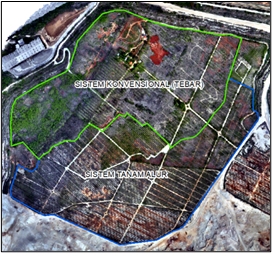
The mining industry contributes significantly to economic development, but it also causes environmental impacts in the form of land degradation, particularly in limestone mining areas, which typically have very thin topsoil layers. This condition complicates the revegetation process and slows down the ecological recovery of the land. This study examines the strip planting system in the limestone mine reclamation area owned by PT X, East Java Province. The objectives of this study are to describe the technical stages of implementing the furrow planting system, describe the actual conditions of the furrow planting system implementation, compare the furrow planting system with the conventional system, and implement the furrow planting system on new land. The methods used are a combination of qualitative and quantitative approaches. Primary data required included soil quality, surrounding vegetation, planting distance, and row spacing, while secondary data required included WIUP data, RR documents, geological maps, plant height, plant diameter, and number of leaves. The results of the study show that the furrow planting system produces optimal teak growth compared to the conventional system. In addition to providing better vegetation growth, the furrow planting system has also been proven to be more efficient in the use of topsoil, requiring only 640 m3/Ha compared to 3000 m3 in the conventional system. Implementing this system on a new 3.2-hectare site is projected to require 2,306 trees and 2,234 m³ of topsoil, with seedlings sourced from stem cuttings. These results indicate that the ridge planting system is an effective and efficient method for supporting sustainable mine land reclamation.
Downloads Statistics
Article Details

 This work is licensed under a Creative Commons Attribution-NonCommercial 4.0 International License. Any further distribution of this work must maintain attribution to the author(s) and the title of the work, journal citation and DOI.
References
Adil, Ahmad. 2023. Metode Penelitian Kuantitatif Dan Kualitatif: Teori Dan Praktik.
Afrizal, Rindhan, Gunawan Nusanto, and Muhammad Tommy. 2017. “Rencana Teknis Reklamasi Pada Lahan Bekas Tambang Block VI PT. Semen Indonesia (Persero) Tbk. Pabrik Tuban Jawa Timur.” Prosiding Seminar Nasional Riset Terapan 5662(November): 50–59.
Government of Indonesia. (2010). Peraturan Pemerintah Republik Indonesia Nomor 78 Tahun 2010 tentang Reklamasi dan Pascatambang.
Kritis, Lahan. 2020. Implementasi Sistem Alur Revolusi Restorasi.
Lubis Erlan, Pratiwi, Yuniar, Rodiyah Nursani, and Jurusan Teknik Pertambangan. 2024. 2 Analisis Revegetasi Pada Lahan Reklamasi Disposal I Tambang Batu Kapur Di PT Semen Baturaja Tbk Analysis of Revegetation on the Reclamation Land of Disposal I Limestone Mine at PT Semen Baturaja Tbk, Ogan Komering Ulu, South Sumatra.
Sukandarrumidi. (2009). Reklamasi dan Penutupan Tambang. Yogyakarta: Gadjah Mada University Press.
Tarigan Agrifa, Susanto Taufiq, Martono L.Slamet, Yunus Mukhammad. 2020. Implementasi Sistem Alur Revolusi Restorasi.
Yunanto, T., Amanah, F., & Wisnu, N. P. (2021). The possibility of reclamation criteria success in Indonesia: Soil condition, vegetation structure and species composition. Journal of Degraded and Mining Lands Management, 9(1), 3201–3210.